Austin / Central Texas Real Estate News & Updates

Keep up to date with the latest Central Texas real estate trends and news.

Thursday, May 30, 2013

10 reasons why so many people are moving to Texas - BBC

Original Post: http://www.bbc.co.uk/news/magazine-22649624


10 reasons why so many people are moving to Texas


Icons of Texas
Half of the 10 fastest-growing cities in the US are in Texas, according to new figures. Why?
Every way you look at it, there are a lot of people moving to Texas.
Five of the 10 fastest-growing cities in the country between 2011 and 2012 were in Texas, according to new figures from the US Census Bureau. New York is way out in front in terms of added population, but Houston is second with San Antonio and Austin fourth and fifth.
Graph showing fastest growing cities
In terms of percentage growth, it's even more Texas, Texas, Texas. Among the five cities that grew most, as a proportion of their size, between 2011 and 2012, three are Texan. San Marcos is out in front with the highest rate of growth among all US cities and towns - 4.9%.
Some of this Texan population boom is due to a natural increase - more births than deaths - but the numbers moving into the state from elsewhere in the US and from abroad far outstrip every other American state. Why?
1. Jobs
"I don't think people go for the weather or topography," says Joel Kotkin, professor of urban development at Chapman University in Orange, California. "The main reason people go is for employment. It's pretty simple.

Most new arrivals 2011-12

  • Texas: 210,590
  • N Carolina: 60,106
  • Virginia: 40,844
"The unconventional oil and gas boom has helped turn Texas into an economic juggernaut, particularly world energy capital Houston, but growth has also been strong in tech, manufacturing and business services."
Critics have questioned whether the "Texas miracle" is a myth, based on cheap labour and poor regulation.
But Kotkin says Texas has plenty of high-wage, blue-collar jobs and jobs for university graduates, although people looking for very high-wage jobs would probably head to Seattle, San Francisco and New York.
Four of the top 10 metropolitan areas for job growth in 2013 are in Texas, according to Kotkin's website, New Geography.
Texas also has a huge military presence, which grew as defence spending increased in the decade after 9/11. Many retired Texans first came to the state as service personnel.
2. It's cheaper
Once employed, it's hugely important that your pay cheque goes as far as possible, says Kotkin.

Fastest growing cities in US (%)

  • 1: San Marcos, Texas (4.91)
  • 2: South Jordan, Utah (4.87)
  • 3: Midland, Texas (4.87)
  • 4: Cedar Park, Texas 4.67)
  • 5: Clarktown, Tenn (4.43)
  • 6: Alpharetta, Georgia (4.37)
  • 7: Georgetown, Texas (4.21)
  • 8: Irvine, California (4,21)
  • 9: Buckeye, Arizona (4.14)
  • 10: Conroe, Texas (4.01)
US Census Bureau, 2011-12
"New York, LA and the [San Francisco] Bay Area are too expensive for most people to live, but Houston has the highest 'effective' pay cheque in the country."
Kotkin came to this conclusion after looking at the average incomes in the country's 51 largest metro areas, and adjusting them for the cost of living. His results put three Texan areas in the top 10.
Houston is top because of the region's relatively low cost of living, including consumer prices, utilities and transport costs and, most importantly, housing prices, he says.
"The ratio of the median home price to median annual household income in Houston is only 2.9. In San Francisco, it's 6.7.
"In New York, San Francisco and LA, if you're blue-collar you will be renting forever and struggling to make ends meet. But people in Texas have a better shot at getting some of the things associated with middle-class life."

Texans who've left their mark on the world

Composite image showing, from left: Roy Orbison, Joan Crawford, Jayne Mansfield and George W Bush
  • Roy Orbison (pictured, first) was born in the small town of Vernon, in 1936, months before fellow rock 'n' roll great Buddy Holly, from nearby Lubbock
  • Joan Crawford(second), born Lucille Fay LeSueur to a poor San Antonio family, was famous for accepting an Oscar while ill in bed
  • As JR Ewing, Fort Worth's Larry Hagman became the face of long-running soap Dallas and just about the most famous man in Texas
  • Also robbers Bonnie and Clyde, singer Janis Joplin, country star Willie Nelson, cyclist Lance Armstrong, actress Jayne Mansfield(third)
  • Texas has produced two presidents: Lyndon Johnson and Dwight Eisenhower. Connecticut-born George W Bush (fourth) grew up there

3. Homes
Land is cheaper than elsewhere and the process of land acquisition very efficient, says Dr Ali Anari, research economist at the Real Estate Center at Texas A&M University.
"From the time of getting a building permit right through to the construction of homes, Texas is much quicker than other states.
"There is an abundant supply of land and fewer regulations and more friendly government, generally a much better business attitude here than other states."
This flexibility, plus strict lending rules, helped to shield the state from the recent housing market crash.
4. Low tax

'I moved because I had to'

Ryan and Jeff
Jeff Paradise, 32, works for an insurance company and relocated to Dallas in 2011, but he often returns to see his partner, Ryan (above left), in his native New York.
"I've been to quite a lot of cities in the US and Dallas is probably my least favourite. The one reason I'm here is for a financial purpose. I have a really good job but I work about 70-80 hours a week so if I had more free time, I would do more. It's a new American city, all sprawled out, because it came of age in the 60s and 70s when it was all about cars and highways. But it's definitely changed the last 5-10 years and they are trying to improve the public transport. I get the train and it's clean, on time and cheaper than New York."
Texas is one of only seven states where residents pay no personal state income tax, says Kay Bell, contributing tax editor at Bankrate and Texan native.
The state has a disproportionate take from property taxes, which has become a big complaint among homeowners, she adds. But overall, only five states had a lower individual tax burden than Texas, according to Tax Foundation research.
There are also tax incentives for businesses and this week legislators cut more than $1bn off proposed business taxes.
5Pick your own big city
Texas has six of the country's 20 biggest cities, says Erica Grieder, author of Big, Hot, Cheap and Right: What America Can Learn from the Strange Genius of Texas.
Contrast this to, for example, Illinois, where if you want to live in a big city you can live in Chicago or you have to move out of state, she says.
But if you're in Texas you can be in Houston, San Antonio, Dallas, Austin, Fort Worth, or El Paso.
6. Austin in particular

Why I live in Austin

James McMurty
"Houston is a city, San Antonio is a city but Austin doesn't feel like that to me," says Texan-born folk singer James McMurty.
"I like it because it's equidistant to each coast so I can get in my van and drive to the west coast and drive around there for three weeks and then come home and do the same on the east coast and still have a life.
"It's far enough south that it doesn't get too cold and you don't get many twisters. And it's a blue dot [Democrat] in a red sea."
Restaurant manager Christopher Hislop, 33, moved in 2007 from Los Angeles to Austin, where he met his wife and they now have a nine-month-old boy.
"I came to Austin for a wedding and thought it was a really cool city and the people were nice - it was everything that LA wasn't but still had that hip vibe without pretension. The nightlife is great and there's an emphasis on getting out and about - they maintain trailways and nature.
"It's not Texas at all and that's what I liked about it. I don't know Texas very well, I grew up in Chicago, but Austin is not Texas because you think of 10-gallon hats and guys on horseback. It's a cliché but Austin isn't like that, it's hip and in the now. The rest of Texas is very conservative."
People like to perpetuate a myth that Austin is still the Austin it once was, says Joshua Long, author of Weird City: Sense of Place and Creative Resistance in Austin, Texas. So as it's become a big city, a movement has developed to "keep it cool, keep it weird and keep it environmentally friendly".
7. Family-friendly
Because of its good-value housing, Texas has been particularly popular with families, and some of its cities now have an above-average number of children. San Antonio is home to the largest community of gay parents.
In Texas, you can have a reasonable mortgage and pretty good schools, says Grieder. And restaurants are invariably family-friendly.
"You hear about the high drop-out rate but Texas education scores pretty well at national tests for 4th and 8th graders in math, reading and science. The aggregate is about average.
"The perception is that Texas has poor schools but it's not correct. Across the country in general, we don't have schools as good as we would like them to be."
In eighth-grade maths, for instance, Texas scored higher than the national average and outscored the three other big states of California, New York and Florida. On Sunday, an education budget was approved that restored cuts made in 2011.
8. Fewer rules

And why some might not move to Texas

University of Texas Longhrons in action
  • The weather - summer is hot. Very hot
  • Congestion problems growing in big cities
  • Not well known for fun nightlife, outside Austin
  • If you hate American football (above, University of Texas Longhorns), you might be outnumbered
"Texas is liberal in the classic sense, it's laissez-faire, so there's a lack of regulations," says Grieder, and this can apply to the obvious (business regulations) or the less obvious (city rules).
"The classic social contract is - we're not going to do a ton to help you but we're not going to get in your way. That's not 100% true of the state but there's that strand in the state."
Mortgage lending is an obvious exception. But there has been strong opposition to banning texting while driving and a proposed tax on soda.
And Governor Rick Perry is poised to sign off the strongest email privacy laws in the US, which would require state law enforcement agencies to get a warrant before accessing emails.
9. Texans are normal people
The state likes to proclaim itself as an unpretentious, down-to-earth place where people are easy to get along with.
As John Steinbeck wrote: "Texas has a tight cohesiveness perhaps stronger than any other section of America."
And for people with conservative values, it could be a natural home, although demographic shifts have prompted speculation it will be a Democratic state in the future.
People dream about moving to California, but they don't dream about moving to Texas, says Grieder, yet many of those reluctant to move there end up liking it.
She adds: "[They] realise that Texans aren't all Bible thumping, gun-toting people. The job is the trigger to come but you find it's pretty nice to live here."
10. And they're not going anywhere
All this doesn't just bring in new arrivals - native Texans aren't leaving the state either. It is the "stickiest" state in the country, according to the latest figures from the Pew Research Center, which suggest that more than three-quarters of adults born in Texas still live there. Alaska is the least sticky.

Labels: , ,

Tuesday, March 26, 2013

Austin = #1 for Young Adults!

Original Post: http://www.bizjournals.com/bizjournals/on-numbers/scott-thomas/2013/03/austin-san-jose-and-washington-are.html?page=all

Mar 26, 2013, 3:53pm EDT

Austin, San Jose and Washington are the best places for young adults

iStockPhoto
More than 1.8 million U.S. students will be picking up bachelor's degrees this Mayand moving on to the next phase of their lives.
Where should they focus their job hunts?
The ideal options, according to a new study by The Business Journals, are Austin, San Jose and Washington. They're the metropolitan areas that offer the best chance for young adults to establish themselves in post-recessionary America.

2013 RANKINGS OF BEST PLACES FOR YOUNG ADULTS


Austin holds first place in the rankings of the nation's 102 major markets. (The study defines a major market as any metro with a population above 500,000.)
Rapid expansion is the reason why Austin has become the ultimate land of opportunity for men and women in their 20s and early 30s. Texas' capital region leads the country in both population growth (3.1 percent per year) and private-sector job growth (1.5 percent annually since 2007).
The two runners-up, San Jose and Washington, feature high income levels and well-educated workforces. No market has a bigger percentage of young adults with incomes above $150,000 than San Jose, and none can surpass Washington's percentage of 18- to 34-year-olds who hold bachelor's degrees.
The next two slots in the rankings of best places for young adults are occupied by No. 4 Boston and No. 5 Houston. Rounding out the top 10 are Durham, N.C.; Oklahoma City; Des Moines, Iowa; Denver and Raleigh.
The Business Journals analyzed the latest federal statistics for all 102 markets, searching for qualities that would appeal to workers in their 20s and early 30s. The study’s 10-part formula gives the highest scores to markets with strong growth rates, moderate costs of living, and substantial pools of young adults who are college-educated and employed.
The following list shows the top-rated markets in each of the 10 statistical categories.
The first five indicators deal with each area’s growth rate and potential. The next four factors assess conditions for young adults. The final category focuses on a key component of the cost of living. (Details about these categories can be found in the methodology.)
  • Population growth: Austin, 3.1 percent per year
  • Long-term private-sector employment growth: Austin, 1.5 percent per year
  • Short-term private-sector employment growth: Austin, 4.6 percent per year
  • Per capita income: Bridgeport-Stamford, Conn., $78,504
  • Long-term income growth: McAllen-Edinburg, Texas, 4.0 percent per year
  • Share of all residents who are between the ages of 18 and 34: Provo, Utah, 32.9 percent
  • Annual unemployment rate for workers between the ages of 16 and 34 (lowest):Madison, Wis., 8.1 percent
  • Share of householders under the age of 45 with household incomes of $150,000 or more: San Jose, 25.5 percent
  • Share of people between the ages of 18 and 34 who hold bachelor’s degrees:Washington, 38.6 percent
  • Median rent (lowest): McAllen-Edinburg, Texas, $456 per month
The Business Journals have also divided this year's rankings along regional lines, with Washington, Austin, Des Moines and San Jose emerging as the leaders.
Below are the five best markets for young adults within the nation's four regions. Each metro is followed by its U.S. rank in parentheses.

East

  1. Washington (3)
  2. Boston (4)
  3. New York City (13)
  4. Baltimore (23)
  5. Pittsburgh (26)

South

  1. Austin (1)
  2. Houston (5)
  3. Durham, N.C. (6)
  4. Oklahoma City (7)
  5. Raleigh (10)

Midwest

  1. Des Moines, Iowa (8)
  2. Madison, Wis. (11)
  3. Omaha (17)
  4. Columbus (20)
  5. Minneapolis-St. Paul (21)

West

  1. San Jose (2)
  2. Denver (9)
  3. San Francisco-Oakland (12)
  4. Seattle (14)
  5. Salt Lake City (16)
The least desirable market for young adults, according to The Business Journals study, is Cape Coral-Fort Myers, Fla. It has been losing jobs at the pace of 2.5 percent per year since 2007, and only 18.3 percent of its residents are between the ages of 18 and 34.
Also in the bottom five, counting up from 101st place, are the Sunbelt markets of Modesto and Riverside-San Bernardino, Calif., and Bradenton-Sarasota and Palm Bay-Melbourne, Fla.

Labels: , ,

Thursday, April 12, 2012

Austin #2: The Best Cities To Buy A Home Right Now

2. Austin, TX

Median List Price: $229,500 (up 12% y-o-y)

Inventory Level: 8,329 homes for sale (down 19% y-o-y)

Median Days On Market: 77 (down 21% y-o-y)

Price Drop From Peak:2.9%

Unemployment Rate: 6.1%

To determine the best places to invest in real estate right now, Realtor.com created a list which sorted through February housing and jobs data for 146 Metropolitan Areas (cities and their neighboring suburbs) across the U.S.  The company looked at listing price data, sales data and inventory trends such as the amount of homes available in each market and number of days on market. Realtor.com also utilized the peak-to-trough home price index from Fiserv Case-Shiller, which tracks how much home prices have fallen in the past five years and unemployment rates from the Bureau of Labor Statistics, since jobs (or lack thereof) are a leading indicator of housing demand.

Full article:
The Best Cities to Buy a Home Right Now!
By: Morgan Brennan, Forbes Staff

Labels: , ,

Friday, January 14, 2011

Austin #1: Best City For College Grads

Americans value mobility. But if you want to move up in the world, sometimes you have to move, literally. In a recession, that's a problem.

In 2010, migration within the United States slowed to its lowest rate in recorded history, according to new research from William Frey at the Brookings Institution. Among college graduates, the story is particularly striking. Here are the 10 most popular cities for college graduates since the recession:

Frey's analysis challenges the story of the 2010 Census, which is the Rise of the Sun Belt. In the last decade, 7.5 million people — more than the total population of Massachusetts and Vermont — moved to Texas and California, while Arizona and Nevada led the nation in pace of growth. Imagine a river flowing from the northeast to the southwest, and you've got a sense of America's general migration pattern.

That's changing, fast. At the height of the housing boom, the most popular destinations for college graduates were Phoenix, Seattle, Atlanta, Riverside (CA), and Charlotte. But when the bubble burst, Texas cities have zoomed up the list: Austin and Dallas were the most popular destinations for bachelor degree earners between 2007 and 2009.

[See America's Best Cities for Young Professionals]

"In 2005-2007, college-educated adults, like other segments of the population, were strongly attracted to "bubble" metro areas like Riverside, Phoenix and Las Vegas," Frey writes. After the burst, degree-earns are clustering in more "knowledge economy" metros, like Austin, Raleigh, Charlotte and Seattle.

According to Frey's figures, the five metro areas with the highest concentration of people with bachelors degrees are: Washington, D.C./Arlington (47%), San Francisco (43%), San Jose (43%), Boston (42%), and Raleigh (42%). The most popular destination in America, Austin (38%), is number six on that list. New York City (36%) is number ten.


When I asked Frey to call out some of the more surprising results of his analysis, he pointed out that interstate migration rates have generally fallen over the last few decades, but the recession accelerated the trend.

Why didn't the recession increase migration, sending families fleeing from weak states like Florida to stronger states like Texas? Frey answered: "The financial crisis meant families couldn't get a loan to get a house. They couldn't sell a house. They were frozen in place because of the housing market and the paucity of jobs."

[See American Cities That Are Running Out of People]

In his Brookings paper, Frey concluded by sounding the alarm on slow interstate migration:

The recent more tentative migration patterns of the younger and "best and brightest" segments of our population are holding back the free flow of human and social capital that has made our society more vital and dynamic than most of our developed country peers. This slowdown, in addition to the decline in immigration can be expected to pick up when the economy revives. But if it takes too long, we run the risk of creating a "lost generation" of young adults, the likes of which we have not seen for some time.


1. Austin, Texas

Percent with BA: 38
Austin is one of the most resilient cities in the U.S., buffeted by state government spending, a large public university and a thriving high-tech sector. It is also the most dynamic city in the United States, according to the Brookings Metropolitan Policy Program, a mecca for music lovers, and a cultural jewel of the South. It's got brains, it's got growth: Indeed, Austin could be America's hottest city at the moment.

 2. Dallas, Texas

Percent with BA: 30
The second most popular city in the Texas is also the second most popular city in the country for college grads. Credit the ample housing, the legendary (if recently disappointing) sports franchises, and the legendary and non-disappointing tech and and transportation industries.

3. Phoenix, Ariz.

Percent with BA: 27
The sun is fun, but is it enough? Phoenix is a city that has, in the last few years, lived up to its namesake. The second-fastest growing metro in the 2000s (after Las Vegas) got rocked by the recession, and median home prices are down 43 percent from their peak in 2009. Phoenix has been on Brookings' list of 20 weakest city economies for more than a year.

4. Portland, Ore.

Percent with BA: 34
What is it about Portland? Despite an unemployment rate over 10 percent, the city has drawn hoards of young, creative, educated graduates in the last few years. Frey chalks it up to a unique cult status. "If you're going to be underemployed somewhere," he said, "you might as well embrace the lifestyle." Here, here!
 
5. Houston, Texas

Percent with BA: 28
One of three Texas on this list, the largest city in the Lone Star State isn't just an oil town, anymore — but recovering oil prices aren't exactly hurting the economy, either. An expanded biotech sector and an aeronautical cluster draw brains and BAs from across the country — if they can stand the infamous humidity.

6. Seattle, WA

Percent with BA: 37
Seattle has long been a magnet for young brainiacs looking to either start their own firm or work for a major corporation. As the headquarters for Amazon, Microsoft, it's a major draw for other companies in the Web-and computer-tech business. The city gets an additional boost from the temperate weather (for those who don't mind the misty rain) and a coffee culture that makes it something like a modern Vienna.

7. Atlanta, GA

Percent with BA: 34
It's no surprise that only Deep South city on this list arguably has the region's best school: Emory University. Before being slammed by the recession, Atlanta was the 3rd most popular destination for both college grads and young people between the ages of 25 and 34. Today it ranks 7th among both groups.

8. Riverside, CA

Percent with BA: 19
Nice weather! But Riverside's inclusion in the top ten is somewhat an artifact of the housing bubble. Only 19 percent of its population holds a BA, by far the lowest on this list. Once the most popular destination for young people during the bubble, Riverside's attractiveness took a hit in the recession. Brookings recently called Riverside one of the worst performing metro areas in the country, based on growth, housing and employment. But still: nice weather!

9. Raleigh, NC
Percent with BA: 42
The Research Triangle of Duke, UNC and NC State make Raleigh an inevitable destination for young degree-earners on the move — especially if they're interested in medicine or looking to go back to graduate school. But Raleigh is more than a college town. It's also a blooming high tech center, with IBM among its highest employers.

10. Tampa, FL
Percent with BA: 26
On the one hand, Tampa and St. Petersburg have every reason to be on this list, with beautiful weather, large universities, and hordes of young people. But consider the headwinds: the Tampa-St. Petersburg area has one of the worst housing markets in the country (Brookings puts it in the bottom quintile) and a relatively low share of bachelors degree earners.
____________

This cities were ranked by total migration among BA earners. But as a percentage of total population, the cities with the fastest growing college-educated community are (in order): Austin, Raleigh, Portland (Ore.), Riverside, Phoenix, Charlotte, San Antonio, Tampa, Nashville, and Kansas City.


by Derek Thompson

Friday, January 14, 2011

Labels: , , ,

Sunday, September 5, 2010

Top 10 Cities for Young Adults

Free from ties to kids or a mortgage, young adults can settle virtually anywhere they choose. So which place is best for you when the world is your oyster?

Here are 10 cities in the U.S. that offer exceptional opportunities for those starting out in life. We began our search using the criteria we used to select our overall list of Best Cities for the Next Decade: healthy economies fueling new job growth. We fine-tuned our search using other youth-friendly factors such as large percentages of people under 35, cost of living and rental costs, culture, nightlife, and the time you're likely to spend in traffic.

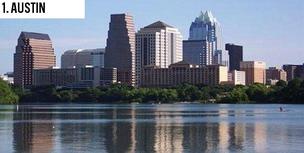
1) Austin, TX
2) Charlotte, NC
3) Chicago, IL
4) Houston, TX
5) Kansas City, MO
6) Lansing, MI
7) New York, NY
8) Portland, OR
9) Salt Lake City, UT
10) Washington, D.C.

By Caitlin Dewey
Kiplinger.com

Labels: , ,